
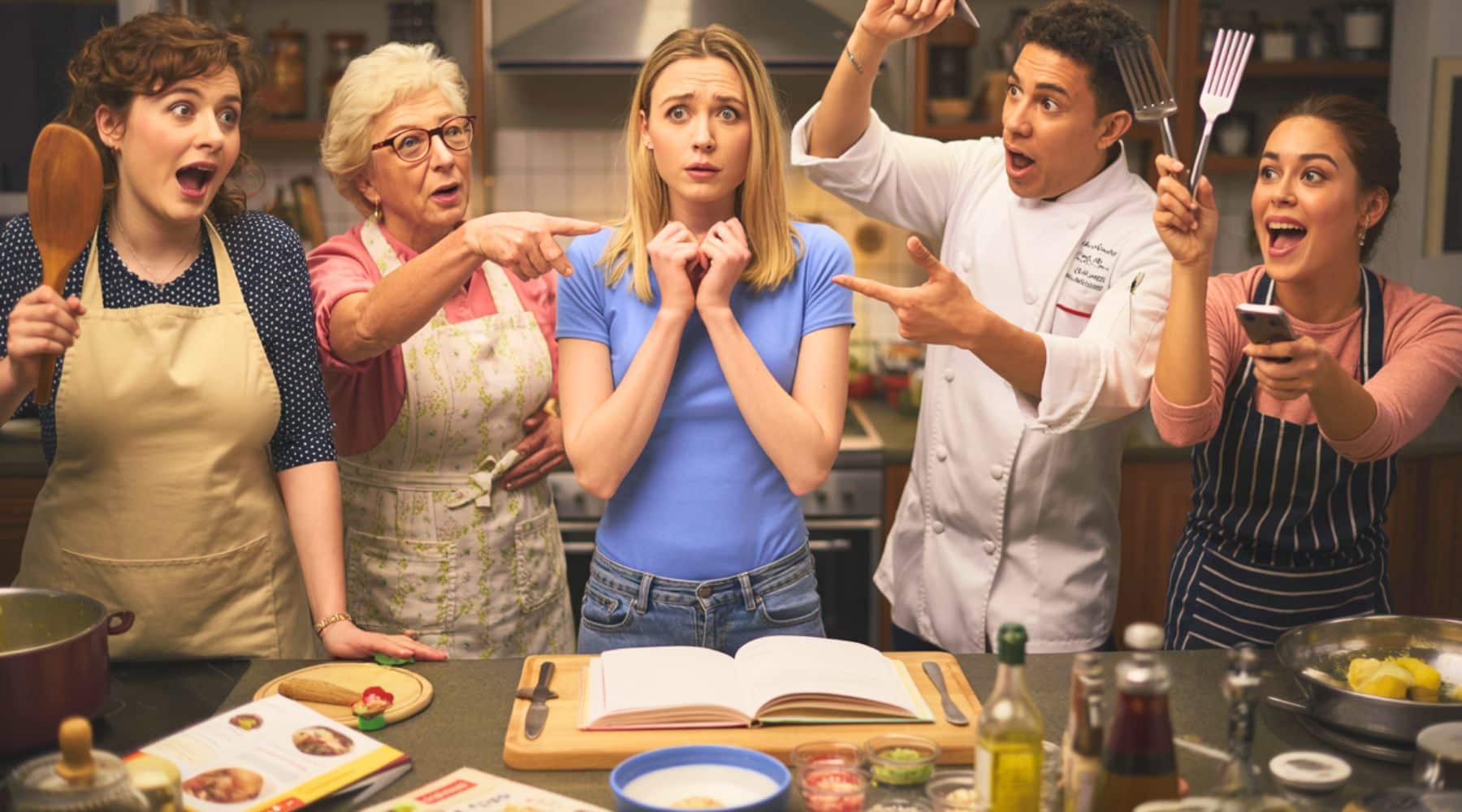
7 kitchen tips that sound helpful – but make cooking harder for beginners
There’s a point where cooking doesn’t stop working because you’re not paying attention –
but because you’re trying to follow too many “good tips” at once.
Parents, friends, TikTok videos, comments, recipes.
Everyone says something. You follow them with good intentions… and somehow the results get worse.
Food sticks. It burns. It’s bland. You rush. You panic.
And then the unspoken thought shows up:
“Everyone else can do this. So it must be me.”
But it’s not.
The real problem is that many kitchen tips just aren’t meant for beginners.
They’re built on experience, not explanation.
And when they’re given without context, they do more harm than good.
This article isn’t saying these are bad tips.
It’s saying they’re given at the wrong time, to the wrong person, without the right background.
Why “good-sounding” advice is dangerous for beginners
Most kitchen advice is really shorthand –
a complex experience compressed into a single sentence.
The problem is that as a beginner:
– you take it literally,
– you don’t yet have your own experience behind it,
– you don’t know what it applies to — and what it doesn’t.
That’s how useful experience turns into a misleading rule.
Let’s look at seven tips that are usually meant well —
but that beginners should handle with caution.
1. “Always start on high heat”
Why it sounds good:
It’s fast. Decisive. It feels professional. The pan sizzles and you think, “Okay, now I’m cooking.”
Why it hurts beginners:
High heat leaves no room for mistakes. One moment of hesitation and the food burns.
Instead of learning, beginners panic.
A better frame:
Heat isn’t a speed booster – it’s a control tool.
As a beginner, you don’t learn faster by going faster. You learn by slowing down.
2. “Just follow the recipe exactly”
Why it sounds good:
It promises safety. It takes responsibility off you. If something goes wrong, “it’s not your fault.”
Why it hurts beginners:
Because it shuts down observation. You watch the recipe — not the food.
And when something doesn’t match the instructions, you don’t know what to do.
A better frame:
A recipe is a map, not a GPS.
It shows direction, but it doesn’t see traffic.
3. “Don’t touch it – let it do its thing”
Why it sounds good:
It teaches patience – at least in theory.
Why it hurts beginners:
Because it removes learning moments from the process. If you don’t observe or react, there’s no feedback.
A better frame:
The question isn’t whether you touch it –
it’s why and when.
4. “Don’t taste too much”
Why it sounds good:
It sounds disciplined. “Don’t mess it up.” There’s authority in it.
Why it hurts beginners:
Because tasting never develops. And by the end, it’s too late to fix anything.
A better frame:
Tasting isn’t judgment – it’s feedback.
If you don’t taste, you’re driving blind.
5. “The more tools you have, the easier it gets”
Why it sounds good:
Buying things feels like progress. Like you’ve already done something.
Why it hurts beginners:
Every new tool adds decisions. Attention shifts away from the food.
A better frame:
Fewer tools → fewer decisions → more attention on what’s cooking.
6. “If you mess it up, throw it out and start over”
Why it sounds good:
Clean slate. Perfectionism. “That’s how it should be.”
Why it hurts beginners:
Because it removes learning. A “ruined” dish is often information.
A better frame:
Most food can be fixed.
And even if it can’t – it still teaches you something.
7. “Cooking requires instinct”
Why it sounds good:
It’s romantic. The talent narrative.
Why it hurts beginners:
Because it shuts learning down. If you don’t have it, “you never will.”
A better frame:
“Instinct” is trained attention.
Observation, repetition, feedback.
Not bad advice – just bad timing
These tips aren’t wrong.
But without experience, they’re misleading.
As a beginner, you don’t need more rules.
You need explanations – understanding why things happen.
Cooking isn’t a discipline test.
It’s not a character exam.
It’s not a talent audition.
It’s a learning process.
Leave feedback.
Explore more:
What makes a kitchen usable
Not pretty. Not trendy. Just functional. The Pinterest kitchen as a bad benchmark “My kitchen isn’t like this. No wonder cooking doesn’t work…
Your first kitchen: what you actually need in the first 30 days
What to get in the first 30 days – and what not to The overwhelming moment of your first kitchen One of the…
Why “perfect” kitchen organization doesn’t work for beginners
Kitchen organization for beginners: why “perfect systems” don’t work When the “good system” lasts three days Does this sound familiar? One Sunday afternoon,…
Is cooking a basic life skill – or just a hobby now?
Cooking isn’t a hobby – it’s basic literacy. Or is it? The statement that divides people “Cooking is basic literacy.” For a lot…