
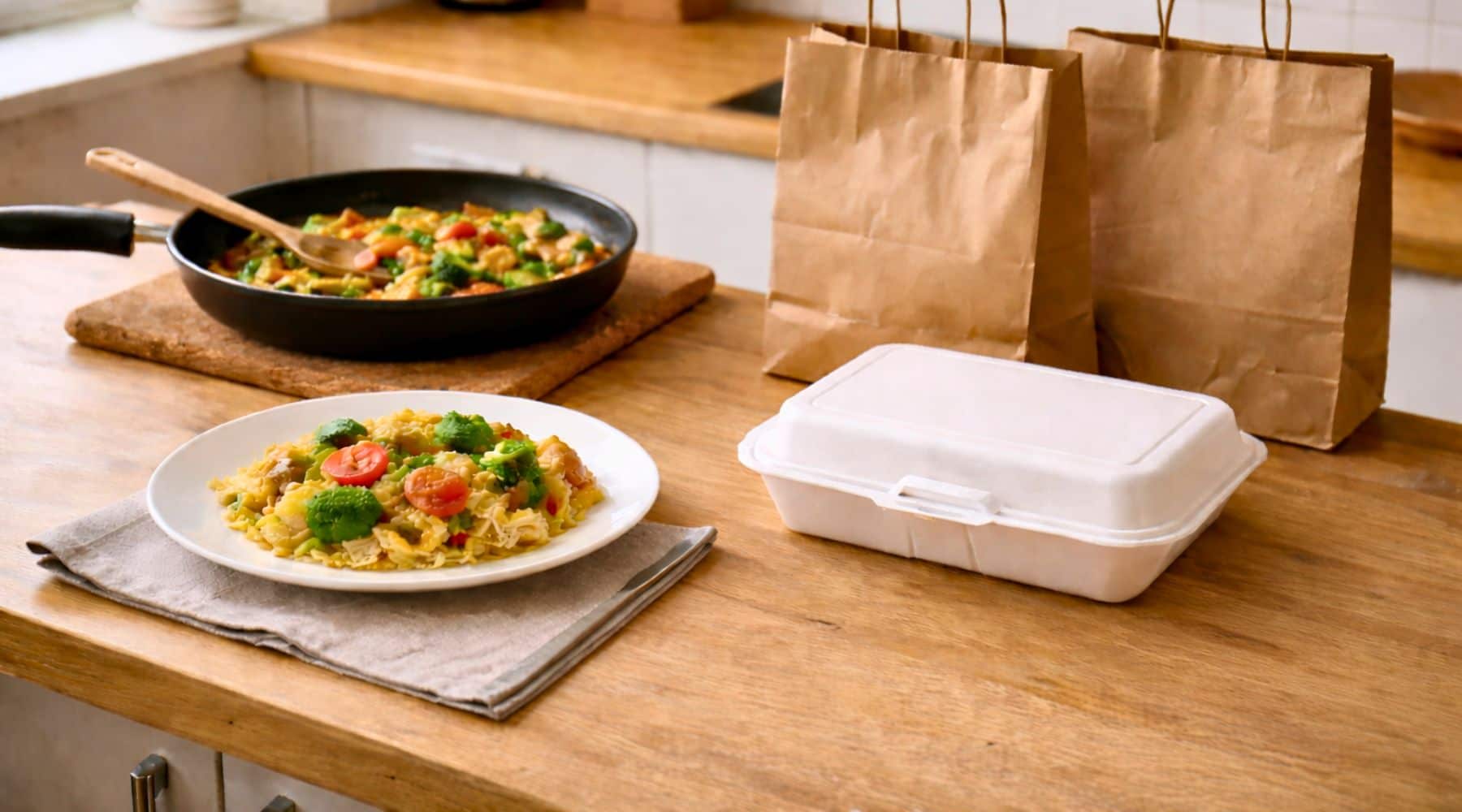
Is cooking a basic life skill – or just a hobby now?
Cooking isn’t a hobby – it’s basic literacy. Or is it?
The statement that divides people
“Cooking is basic literacy.”
For a lot of people, that sentence triggers immediate resistance. In the 21st century, with cafeterias, food delivery, ready-made meals, and microwave solutions everywhere, it’s easy to say this isn’t necessary anymore. It’s good if you can cook — but it’s not required. More of a hobby than a baseline skill.
And yet, it’s worth pausing for a moment.
What does it actually mean today to “know how to cook”? Knowing recipes? Technical tricks? Or something else entirely?
This article isn’t here to judge. It doesn’t tell you whether you should cook. Instead, it looks at what we’ve lost — and gained — by treating cooking as optional.
When was cooking considered basic literacy?
For a long time, cooking wasn’t a choice. It wasn’t identity, self-expression, or a weekend activity. It was survival and self-sufficiency.
If you couldn’t cook, you were dependent — on others, on circumstances, on the community. Knowledge didn’t come from cookbooks, but from observation and passing things down. It was family and community experience.
There was no such thing as “good” or “bad” cooking.
Only working — and not working.
People didn’t cook because they enjoyed it.
They cooked because not cooking had consequences.
That baseline has changed completely.
When – and why – did cooking become a hobby?
Urbanization, lack of time, and the growth of services separated cooking from everyday necessity. Food became available without you having to do anything for it.
At the same time, cooking split in two:
– everyday cooking, which became invisible and undervalued,
– and food as an experience — visual, inspiring, and media-ready.
On social media, cooking turned into performance. Content. Identity. If you cook, you’re not just feeding yourself – you’re producing something.
That inevitably sends a message:
if you can’t do it well, maybe don’t do it at all.
And once something becomes a hobby, it’s no longer mandatory.
It’s optional.
What did we lose when cooking became optional?
First, independence. Not necessarily dependence on one service, but on systems – logistics, delivery, schedules, availability. As long as they work, there’s no problem. The lack of knowledge only becomes visible when something breaks.
Second, foundational knowledge. Understanding how ingredients behave. Knowing what’s made of what, when something spoils, when it can be saved. We lost a sense of time, taste, and the ability to “read” processes.
There’s also a less visible loss: the emotional relationship to cooking.
“I can’t cook” today is often either shame or self-excuse. As if it described a personality trait, not a learnable skill.
But that’s not how it works.
What did we gain in return?
It’s important to be honest: a lot. Flexibility. Time. Freedom of choice. Not everyone needs to cook in every life situation. It’s not realistic for everyone, and it’s not always a priority.
So the question isn’t whether you’re allowed not to cook.
It’s what it means if you can’t.
Not cooking as a choice and not cooking as a lack of ability are two very different things.
Cooking as basic literacy – redefined
If we say today that cooking is basic literacy, we don’t mean that everyone has to memorize recipes or produce technically perfect dishes.
In this sense, basic literacy means something else:
– understanding basic logic (why things happen),
– being able to make independent decisions (what can be substituted, when something can be fixed),
– adapting – not to the recipe, but to the situation.
Seen this way, cooking isn’t performance.
It’s competence.
It’s not about what you can show.
It’s about what you can handle.
Why this matters especially for young adults
For people between 18 and 35, many things in life are uncertain: housing, work, schedules, relationships. There are few areas where you can feel real control.
Cooking could be one of them.
A small, manageable space where you experience self-sufficiency. Not perfection. Not aesthetics. Just the feeling: “I can handle this.”
In that sense, cooking isn’t gastronomy.
It’s stability.
Objection — does everyone need to know how to cook?
No. Not everyone has to love it. Not everyone has to do it regularly. It’s not realistic in every life situation.
But there’s an important difference between not liking to cook and not being able to. The first is preference. The second is dependence.
Knowledge and practice aren’t the same. You can know something even if you rarely use it. But without the foundation, there’s nothing to choose from.
Not mandatory, but not neutral
Cooking today isn’t a survival requirement.
But it’s still a basic human skill.
Not a hobby. Not a duty.
A possibility.
A possibility for independence.
A possibility for understanding.
A possibility to be not just a consumer, but an informed participant in what happens to you every day.
To close, it’s worth asking:
If you never cooked again starting tomorrow, would you know what you’re losing – or only what you’re gaining?
If that question makes you pause, the article has done its job.
And if you want to keep thinking, the related pieces on beginner cooking, core skills, and the logic of the first kitchen continue exactly this line of thought.
Leave feedback.
Explore more:

Why “perfect” kitchen organization doesn’t work for beginners
Kitchen organization for beginners: why “perfect systems” don’t work When the “good system” lasts three days Does this sound familiar? One Sunday afternoon,…
7 kitchen tips that sound helpful – but make cooking harder for beginners
There’s a point where cooking doesn’t stop working because you’re not paying attention –but because you’re trying to follow too many “good tips”…
What makes a kitchen usable
Not pretty. Not trendy. Just functional. The Pinterest kitchen as a bad benchmark “My kitchen isn’t like this. No wonder cooking doesn’t work…
Your first kitchen: what you actually need in the first 30 days
What to get in the first 30 days – and what not to The overwhelming moment of your first kitchen One of the…