
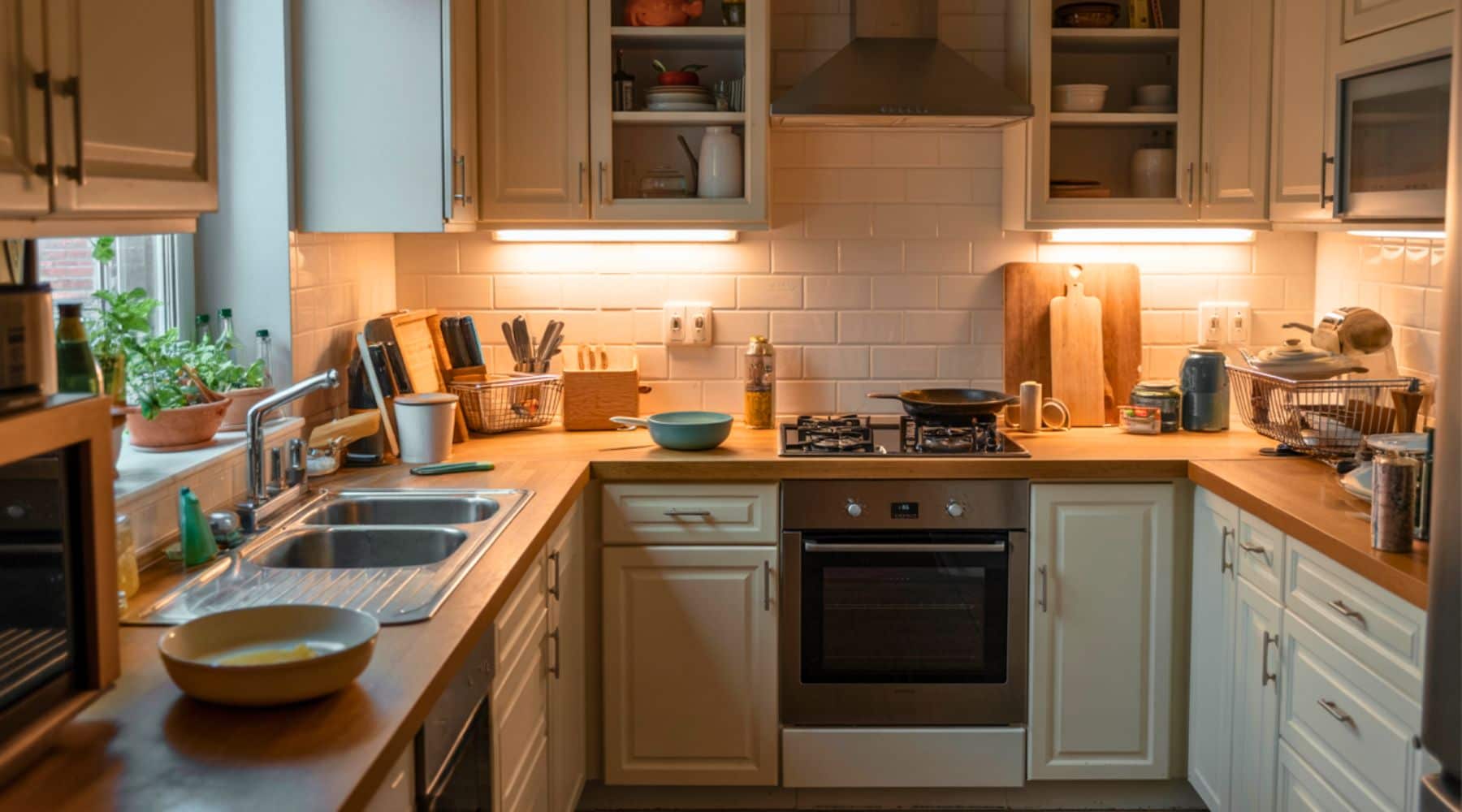
Why “perfect” kitchen organization doesn’t work for beginners
Kitchen organization for beginners: why “perfect systems” don’t work
When the “good system” lasts three days
Does this sound familiar? One Sunday afternoon, you finally organize your kitchen.
Everything has its place. The drawers make sense, the counter is empty, the kitchen looks “like in the pictures.”
You feel relieved.
“Okay. Now cooking will finally work, right?”
Then three or four days pass. A quick dinner. A rushed morning. One evening where you just don’t have the energy to put everything back.
The system falls apart. Things stay on the counter. Not everything goes back exactly where it should.
And you start thinking:
“There must be something wrong with me. I’m just not disciplined enough.”
But what if you’re not the problem – the system is?
This article doesn’t tell you to tidy up.
It doesn’t promise another “perfect” kitchen solution.
It shows why these systems don’t work for beginners – and what kind of mindset actually leads to usable, sustainable order.
Why perfect systems are so appealing
Social media is full of visually perfect kitchens.
On Instagram, TikTok, and Pinterest, order isn’t just practical – it’s a lifestyle symbol.
An organized kitchen has become shorthand for a “put-together life.”
This hits especially hard between the ages of 18 and 30. That phase of life is already full of uncertainty:
– a new apartment,
– a first job,
– little routine,
– lots of expectations – often unspoken.
Order promises control. It suggests:
“If things are in order here, I’ll be okay everywhere else too.”
The problem is that these systems aren’t built for cooking.
They’re built for how things look, not how they’re used.
There’s no rushing in the videos. No half-finished steps. No “I don’t have the energy today.”
Real life is made of exactly those moments.
The big misunderstanding: order as a permanent state
One of the most damaging ideas is that kitchen order is permanent – something you reach once and then just maintain forever.
That’s simply not true.
Cooking involves movement.
Tools. Ingredients. Decisions.
Even experienced cooks don’t have kitchens that are “always tidy.”
The difference isn’t discipline – it’s that they return to a workable state faster.
Beginners often think that a lack of order means a lack of skill.
But chaos isn’t a mistake. It’s part of the process.
The problem isn’t that there’s mess – it’s what you expect order to be.
Why “perfect systems” fail in real life
1. They rely on too many rules
Most systems come with strict instructions: what goes where, how, and when.
That makes sense on paper, but falls apart while cooking.
When you’re paying attention to food, time, and heat at the same time, you don’t have the mental capacity to follow rules.
2. They’re not built around your habits
The system you saw in a video wasn’t designed for your kitchen.
Not for your tools, your schedule, or the way you cook.
If a system doesn’t match your real movements, it will eventually fail.
3. They create a punishment mindset
“If it’s messy, I failed.”
This kind of thinking kills the desire to cook.
The kitchen becomes a place of stress instead of practice.
Order stops being supportive – and starts judging.
What “usable order” actually means in a beginner kitchen
For beginners, kitchen order doesn’t mean everything is clean and empty..
It means the kitchen is:
– easy to read,
– and easy to reset.
Three key principles
– Not cleanliness, but clarity
– Not a system, but a return point
– Not permanence, but rhythm
Key idea:
Good kitchen order doesn’t come before cooking – it follows it.
You cook first.
Then you bring the space back to a “good enough” state.
Five freeing principles that actually work
1. Mess during cooking is normal
If things get messy while you cook, that’s not a problem.
It’s proof that you’re doing something.
The only issue is when there’s nowhere to reset to.
2. Not everything needs a permanent place
Some tools are only used occasionally.
They don’t need a “perfect” spot.
They just need to not be in the way.
3. The counter is a work tool, not decoration
The counter isn’t meant to be empty all the time.
It’s meant to be used.
Things on the counter during cooking don’t signal disorder – they signal active use.
4. Order needs an endpoint, not a shape
Don’t decide what order should look like.
Decide when it’s done.
For example:
“Before bed, I reset the counter to a basic state.”
That’s enough.
5. The most-used items should live in the laziest spots
Anything you use daily shouldn’t require bending, stacking, or searching.
Order works not when it’s pretty – but when it’s convenient.
Mini exercise: how to reach “good enough order” in 5 minutes
If you want to get back to a usable state quickly, ask yourself three questions:
- What will still be here tomorrow?
- Anything you use regularly can stay visible.
- What gets in the way while cooking?
- Move it aside — it doesn’t have to be put away perfectly.
- What can just go into one pile?
- Not everything needs to be returned immediately.
Temporary order is still order.
- Not everything needs to be returned immediately.
This kind of “good enough order” isn’t pretty — but it works.
What changes when you stop focusing on order before cooking?
If you don’t start with “everything has to be tidy first,” but with cooking:
– you procrastinate less,
– you practice more,
– order becomes a side effect, not a requirement.
Kitchen organization stops being a separate project and just becomes part of cooking.
Order isn’t the goal, it’s the byproduct
Perfect systems aren’t for beginners.
A working kitchen isn’t cleaner – it’s more livable.
Order isn’t about discipline. It’s about design.
The real question isn’t whether it’s always tidy.
It’s whether you can return to a usable state.
To close, think about this:
What’s the one spot in your kitchen where “mostly tidy” would be enough?
If you find that, you’re no longer fighting chaos – you’re working with it.
And if you’d like, the related articles go deeper into usable kitchens, first kitchens, and core cooking skills.
Leave feedback.
Explore more:
Is cooking a basic life skill – or just a hobby now?
Cooking isn’t a hobby – it’s basic literacy. Or is it? The statement that divides people “Cooking is basic literacy.” For a lot…

7 kitchen tips that sound helpful – but make cooking harder for beginners
There’s a point where cooking doesn’t stop working because you’re not paying attention –but because you’re trying to follow too many “good tips”…
What makes a kitchen usable
Not pretty. Not trendy. Just functional. The Pinterest kitchen as a bad benchmark “My kitchen isn’t like this. No wonder cooking doesn’t work…
Your first kitchen: what you actually need in the first 30 days
What to get in the first 30 days – and what not to The overwhelming moment of your first kitchen One of the…