
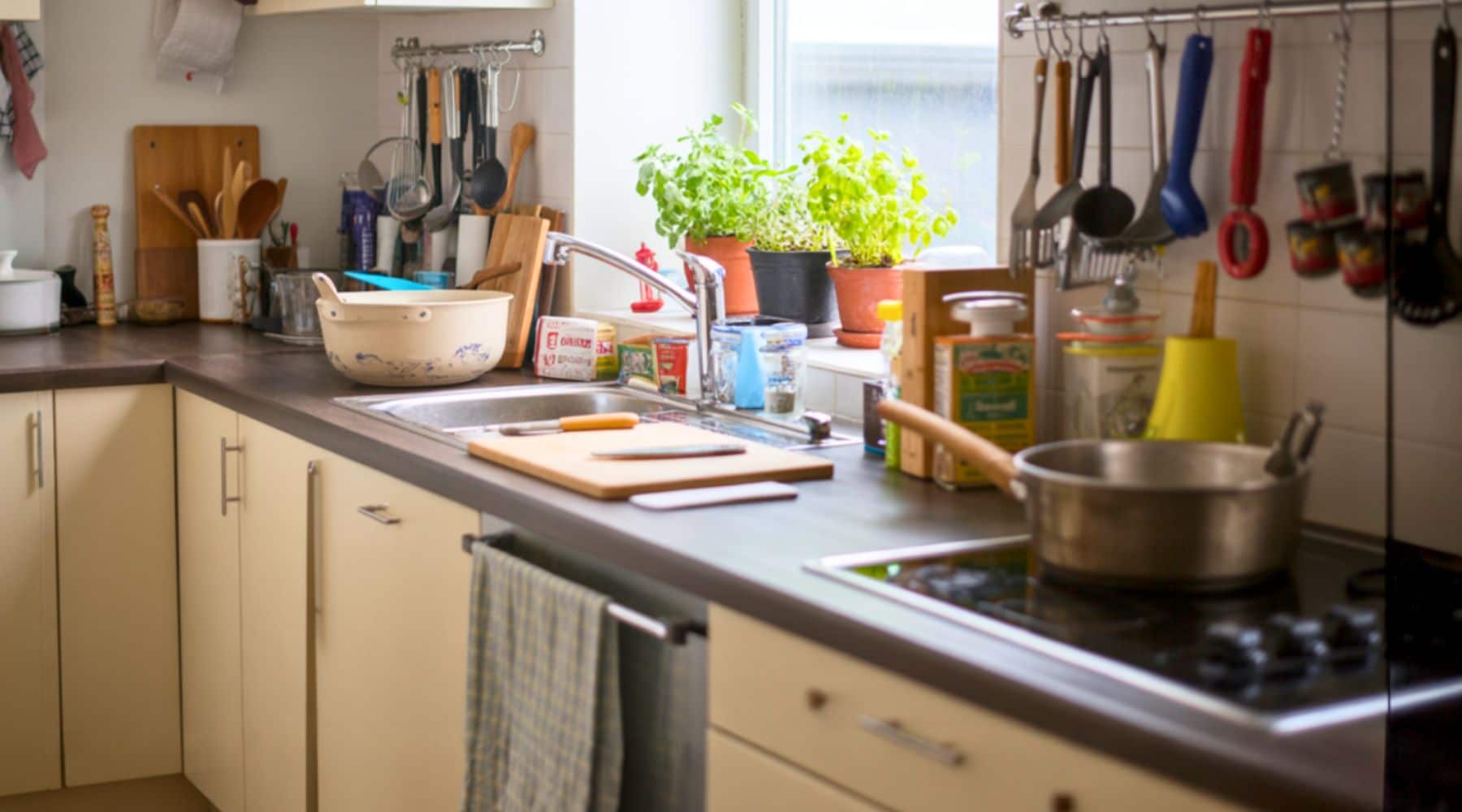
What makes a kitchen usable
Not pretty. Not trendy. Just functional.
The Pinterest kitchen as a bad benchmark
“My kitchen isn’t like this. No wonder cooking doesn’t work in it.”
This thought shows up in the minds of a surprising number of beginners. A few minutes on Pinterest or Instagram is enough to make it seem like a “good” kitchen is always bright, spacious, has empty countertops, and looks perfectly organized. Everything is in its place – and it looks like everything you’d need to cook with confidence is already there.
If your kitchen, by comparison, is small, crowded, and filled with mismatched tools, it’s easy to conclude that cooking doesn’t work because the environment isn’t right.
But what if the problem isn’t your kitchen – but the expectations?
This article helps separate cooking confidence from visual ideals, and looks at what actually makes a kitchen usable.
Not pretty. Not trendy. Just functional.
Why the “beautiful kitchen” narrative misleads beginners
Most Pinterest kitchens follow the same pattern::
– completely empty countertops,
– decorative tools that are rarely used,
– uniform colors and clean lines.
But these kitchens aren’t built for cooking.
They’re built for photos. For a moment. For a setup.
Not for chopping onions, stirring sauces, or making mistakes while cooking.
For beginners, this visual pressure can easily lead you astray. Every bit of mess seems to say, “You’re doing it wrong.” A floured countertop, a pan left out, something not put away — and suddenly it feels like you’re not “good enough” for this at all.
But a kitchen for beginners isn’t an aesthetic project.
It’s a learning space.
And learning is never tidy.
What does it actually mean for a kitchen to be usable?
A usable kitchen isn’t about design.
It’s not about trends or styles. It’s about function.
It comes down to three basic things.
- Accessibility
What you use often should be within reach.
Your knife, cutting board, wooden spoon, and pan shouldn’t live at the back of a hard-to-reach cabinet.
What you rarely use, on the other hand, shouldn’t get in the way.
That’s not clutter.
It’s just how things work.
- Room to move
A working kitchen doesn’t have to be big.
What matters is having a counter surface where you actually work: chopping, mixing, arranging.
One well-placed work area is more valuable than a completely empty counter in the wrong spot.
- Logic
Storage isn’t an aesthetic choice. It’s about sequence.
Pots belong where you cook. Spices belong where you season.
What matters isn’t matching containers – it’s not having to search for things.
The five principles of a functional kitchen
especially important for beginners
- The counter isn’t decoration — it’s a work surface
The “always empty countertop” expectation is one of the most damaging ideas out there.
Counters exist to be used.
A cutting board, a bowl, or a pan absolutely belongs there. If the counter is just decoration, cooking turns into a constant obstacle course.
- Fewer tools = less uncertainty
The more tools you have, the more decisions you have to make.
Which knife? Which pan? Which bowl?
For beginners, this is mentally exhausting. One familiar knife and one reliable pan help more than ten rarely used gadgets.
- Everything needs a “home”
What matters isn’t where something is — but that it always goes back to the same place.
This reduces chaos, speeds up movement, and creates a sense of safety while cooking.
- The kitchen adapts to your habits
It doesn’t have to be “well designed.”
If you always chop in the same spot, that’s where the board should be. If you season there, that’s where the spices belong.
A functional kitchen is personal.
Not a catalog photo.
- Order isn’t a state – it’s a return point
Cooking creates mess. That’s not a flaw — it’s the process.
The question isn’t whether it got messy, but whether there’s somewhere to reset.
Order isn’t something you keep all the time. It’s something you come back to.
Small kitchen ≠ bad kitchen
A lot of people blame the size of their kitchen:
“You can’t cook in here.”
Yet interestingly, many people actually learn to cook better in small kitchens.
Why?
– less movement,
– fewer decisions,
– a clear cooking zone.
One pan, one stretch of counter, and one burner are enough for real cooking.
A small kitchen isn’t a compromise. It’s focus.
What does NOT make a kitchen functional?
This matters to say out loud. A kitchen doesn’t become functional because of:
– expensive equipment,
– matching design,
– trendy storage,
– an “Instagram-friendly” look.
These things can be beautiful. Even inspiring.
But on their own, they don’t help you cook.
Here’s a freeing thought:
your kitchen isn’t being tested. You’re learning in it.
How to create a functional kitchen without changing anything
You don’t need to buy anything. You don’t need to remodel.
You just need to observe.
– While cooking, notice where your movement gets stuck.
– Where do you have to search? Where do you have to step back?
– Choose a single cooking zone and concentrate what you use most there.
A logical rearrangement often does more than any new tool. That alone can lower stress and give you more room to learn.
New question instead of “is it pretty?”
A usable kitchen isn’t a photo-ready ideal.
It’s not a final state.
It’s a living, learning space that grows with you.
It doesn’t work because it’s pretty.
It works because it helps.
Tonight, if you cook, ask yourself this:
What’s the one thing in my kitchen that would actually help – not decorate?
If you can answer that, you’re already closer to a functional kitchen.
And if you’d like, in the related articles I’ll also show which core cooking skills are built on this kind of space.
Leave feedback.
Explore more:
Your first kitchen: what you actually need in the first 30 days
What to get in the first 30 days – and what not to The overwhelming moment of your first kitchen One of the…
Why “perfect” kitchen organization doesn’t work for beginners
Kitchen organization for beginners: why “perfect systems” don’t work When the “good system” lasts three days Does this sound familiar? One Sunday afternoon,…
Is cooking a basic life skill – or just a hobby now?
Cooking isn’t a hobby – it’s basic literacy. Or is it? The statement that divides people “Cooking is basic literacy.” For a lot…

7 kitchen tips that sound helpful – but make cooking harder for beginners
There’s a point where cooking doesn’t stop working because you’re not paying attention –but because you’re trying to follow too many “good tips”…